Learn Print Writing in Just 7 Days
Jump to Print is Write Right's 7-day print writing course for school students. One hour a day, individually taught, no homework — and on Day 7 you see your child's new writing side by side with the sample they wrote on Day 1.
What is print writing?
Print writing — also called manuscript or ball-and-stick writing — is a handwriting style in which every letter is formed separately, with no joining strokes. Each letter closely resembles the printed letters in a textbook, which is why print is the style children learn to read first.
Because the letters are unjoined and the shapes stay geometrically simple, print is the style that comparative handwriting research has most consistently found to be more legible — while studies on writing speed find little meaningful difference between print and cursive. For a student whose marks depend on an examiner reading every word without effort, that combination is the whole argument.
Many Indian schools now specify print for junior classes and for answer sheets. Jump to Print is Write Right's 7-day course for building exactly that style correctly — or rebuilding it when it has gone wrong.
Print vs cursive: what actually differs
| What matters to a parent | Print writing | Cursive writing |
|---|---|---|
| Legibility to an examiner | Highest — letters stay separate and distinct | Depends heavily on execution; joins blur under speed |
| Writing speed | Comparable — no meaningful penalty in research | Comparable; fastest writers usually use a hybrid |
| Ease for a beginner | Simple strokes suit developing motor control | Continuous strokes demand more control |
| Supports early reading | Yes — matches textbook letterforms | Indirect |
| Typical school requirement | Commonly specified for junior classes and answer sheets | Often optional; varies by school |
| Best for | Marks, notes, forms, exams | Flow, personal style, signature work |
| Write Right course | Jump to Print — 7 days | Covered under Handwriting Improvement |
Day 1 beside Day 7
Every Jump to Print student writes a sample on Day 1 before any teaching happens. We keep it. On Day 7 they write the same passage again. Nothing about the improvement is a matter of opinion.
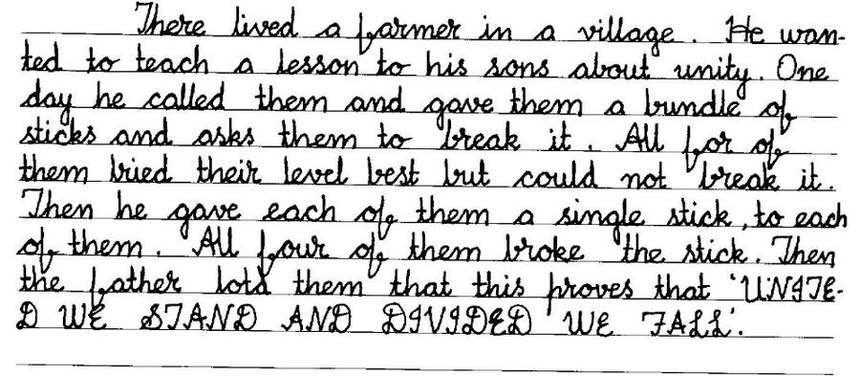
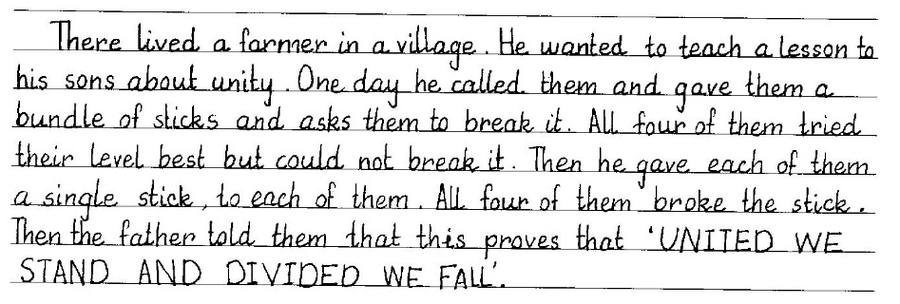
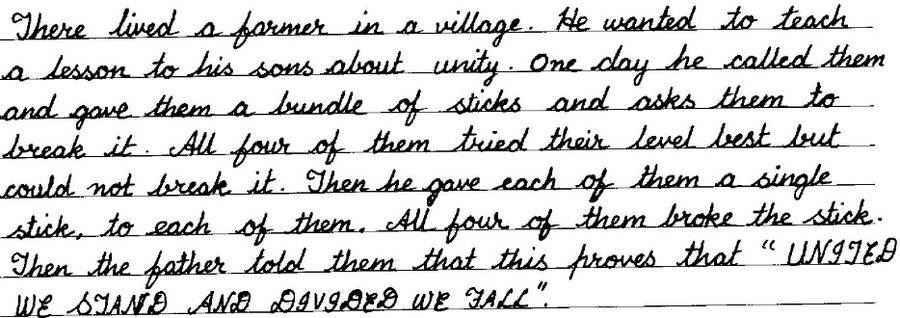
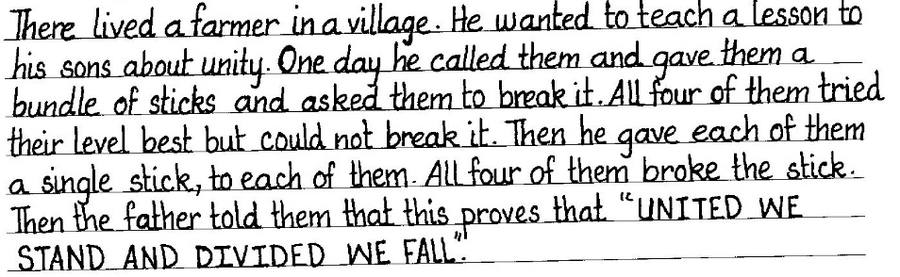
Jump to Print — the complete 7-day print writing course, one hour a day, with a personalised workbook. Your centre confirms batch timings during the free handwriting analysis.
Which Write Right course does my child actually need?
Print Writing — Jump to Print
Your child needs clean, separated print letters — for school-mandated print, single-line notebooks, or answer sheets an examiner can read.
Handwriting Improvement
Writing is illegible in whatever style your child currently uses, or you want cursive included. The flagship general programme, in English and Hindi.
Speed Writing
Already legible but cannot finish a paper in time. Trains writing speed without losing readability — for exams and note-taking.
Jump to Print vs the other four things parents try
Every parent reading this is choosing between the same options. Here is how they actually differ.
| Jump to Print | Practice book at home | General tuition teacher | Longer 14–30 day courses | |
|---|---|---|---|---|
| Time to visible result | 7 days | Months, often none | Open-ended | 2–6 weeks |
| Diagnoses the actual fault | Yes — Day 1 assessment | No | Rarely | Varies |
| Corrects strokes in real time | Yes, every session | No — repeats the error | Sometimes | Usually yes |
| Homework burden on you | None | All of it | Daily | Usually daily |
| Print-specific curriculum | Yes — print is the whole course | Generic sheets | No | Often bundled with cursive |
| Before/after evidence given | Day 1 and Day 7 sheets | No | No | Sometimes |
Print writing FAQs
What is the Jump to Print course?
Jump to Print is Write Right's 7-day print writing course. Over seven one-hour sessions a certified trainer rebuilds your child's print handwriting from the ground up: pencil grip, posture, letter formation, letter height, spacing, baseline control and the shift from four-line to single-line notebooks. It is individualised, uses Write Right's own scientifically designed workbook, and sets no homework.
How long is the Jump to Print course?
Seven days, one hour a day — seven hours of guided writing in total. Most families complete it inside a single week, including during school holidays or exam breaks.
What age can my child start print writing?
The Jump to Print course is open to anyone aged 9 and above, with no upper age limit. It is regularly taken by Grade 8–10 students, and by adults who want cleaner print for forms, notes and professional writing.
Print writing vs cursive writing — which is better for my child?
For marks and readability, print. Comparative handwriting research going back to Gates and Brown (1929) has repeatedly found print to be the more legible style, while studies on writing speed — including Graham, Weintraub and Berninger (1998) — find little to no meaningful speed advantage for cursive. Cursive is worth learning for flow and personal style, but if the goal is an examiner reading every word without effort, print is the safer choice.
Can handwriting really change in 7 days?
Yes, and you do not have to take that on faith. Every student's Day 1 writing sample is kept and placed beside their Day 7 sample, so the change is something you can see rather than something we claim.
What is print writing?
Print writing (also called manuscript or ball-and-stick writing) is a handwriting style in which every letter is formed separately, without joining strokes. Each letter closely resembles the printed letters in a textbook. Because letters are unjoined and shapes stay simple, print is the style research has most consistently found to be the more legible of the two main handwriting styles.
Should my child learn print or cursive first?
Print first, in almost every case. Print letters match the letters children see in their textbooks, which supports early reading, and the simple strokes are easier for developing motor control. Cursive is best added once print letter formation is automatic.
Are classes one-to-one or in a group?
Training is individualised. Even where a small batch shares a session, every student is assessed separately and works through corrections specific to their own letter faults — because no two children form letters wrongly in the same way.
Is there homework?
No. Jump to Print sets absolutely no homework. All writing happens inside the one-hour supervised session, where a trainer can correct a wrong stroke the moment it appears. Unsupervised practice at home is how bad letter habits get reinforced, so we deliberately avoid it during the course.
Are classes available online or only at a centre?
Both. Jump to Print runs at Write Right centres across India and as a live online course for families without a centre nearby. Online sessions stay one hour a day for seven days, with the workbook shipped before Day 1.
What if my child's handwriting does not improve?
The Day 1 and Day 7 samples are compared side by side, so the change is something you can see rather than something we claim. If the Day 7 sample does not show clear improvement, speak to your trainer — the remaining faults are worked on directly rather than left to practice sheets.
My child is in Grade 8 — is it too late?
No. Older students often improve faster, because they can understand and self-monitor a correction that a six-year-old can only be guided into. There is no upper age limit — the course is open to anyone aged 9 and above and is taken by students through Grade 10 and by adults.
Will the improvement last after the course ends?
It lasts when the new stroke pattern has become the automatic one, which is exactly what the seven supervised hours are designed to build. Day 7 deliberately tests the new writing at exam speed, because handwriting that collapses under time pressure has not really been learned. Your trainer will give you a short maintenance routine for the weeks after the course.
What does the Jump to Print course cost?
Fees vary by city and by centre, and by whether you choose centre-based or live online classes. Submit a student inquiry and the nearest centre will share the current fee, batch timings and any sibling or holiday-batch concession. The workbook and materials are included in the course fee.
How do I book a free handwriting analysis?
Fill the student inquiry form on this page and attach or send a photo of one recently written page — ideally a school notebook page, not a specially neat sample. A trainer responds with an assessment and the recommended programme. Go to the form →
Student inquiry
Start with a free handwriting analysis
Send one photo of your child's school notebook page. A trainer will tell you what is going wrong in the writing and whether Jump to Print is the right course. No cost, no obligation.
- A trainer calls you back within one working day
- Written note on what is holding the writing back
- Classes at your nearest centre or live online
- Next batch dates and the exact fee confirmed on the call
Looking for classroom curriculum for a school, or a Write Right franchise? Use the school enquiry or franchise enquiry instead.